How to Streamline Product Sourcing and Business Decisions Using AI: A Step-by-Step Guide

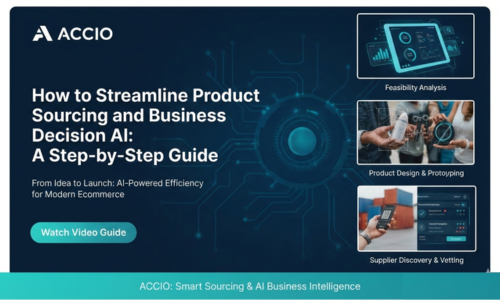
The conduct of a modern eCommerce business or a product-related business is no longer just concerned with identifying a supplier and releasing a product. The current competitive environment requires supported decision-making based on data, market awareness, supplier visibility, and expedited go-to-market capabilities. It is there that sourcing platforms powered by AI are transforming the way business is done, especially in the form of analyzing trends, demand, and finding qualified suppliers all at a single site.
Brands can stop engaging in guesswork and begin to compile smarter product plans with the help of intelligent sourcing software such as ACCIO. Since the concept can be as simple as generating listing visuals and analyzing bestselling products, AI can be utilized in the process of creating a product, starting with the full feasibility analysis, including trends, pricing, and supply.
Step 1: Conduct Full Feasibility Analysis Before Launch
The idea of a product is tested to determine whether it can potentially be a viable product in the market before we commit our time and capital on the product. With AI-based feasibility analysis tools, companies are able to access the current trends, projected price bracket, and supply chain utilization without having to resort to manual research.
This will enable entrepreneurs to authenticate the demand for the products and profitability without going into the manufacturing process. Companies will be able to make informed decisions in advance, which minimizes the financial risk factor and increases the success rates rather than responding to market changes.
Also, AI-based business analytics products can be used to quantify willingness-to-pay on niche groups, such as refillable beauty products, or gauge private label threats in competitive businesses, such as high-end fitness equipment.
Step 2: Transform the Inspiration into the actual Product Designs.
A lot of brands can hardly transfer creative ideas into product designs. Today, AI allows one to translate visual inspiration into conceptualized products that are fully developed and can be based on actual supplier potential.
For instance, businesses can:
- Transform buildings into event gift designs.
- Redesign standard necessities for Gen Z.
- Create accommodating products for different body types.
- Design smart improvements on bestsellers.
- Produce themed products for the seasonal holidays.
Such AI-based design processes enable entrepreneurs to establish communication between ideation and manufacturing. The process will be more time-saving and efficient by matching designs with appropriate suppliers automatically.
Step 3: Find Qualified Suppliers in Seconds.
Identifying trustworthy suppliers is also one of the most time-consuming factors of product development. The current AI sourcing solutions provide companies with an opportunity to post product pictures so that they can find verified manufacturers that can create other similar products.
You can also:
- Browse and filter products based on elaborate specifications.
- Identify producers of small custom orders.
- Find products fast that are certified.
- Research supplier risks prior to the production investment.
- Draft inquiry mails of style-fit factories.
The features will assist in removing sourcing delays besides enhancing the communication between brands and manufacturers - making the production timelines run smoother.
Watch: Step-by-Step Guide to Using AI for Smart Product Sourcing
The automation of sourcing and research is possible through the utilization of AI tools before you release your next product, and these can significantly cut through your workflow. This video illustrates how it is possible to analyze bestsellers, map the leading trends, and verify the compatibility of suppliers with intelligent sourcing platforms.
Step 4: Market Trends and Consumer Pain Point Analysis.
In order to remain competitive, brands should understand customer needs not met and predict demand in the future. AI based product research tool assists companies to:
- Break down viral successes to find inspiration for new products.
- Seasonal trends Map leading indicators.
- Upgrade formulation through innovative track materials.
- Decomposing the pain points to inform new product directions.
- Early adopters and their profile needs.
Companies can learn why some products work and attempt to recreate the aspects that worked rather than create typical design or usability pitfalls.
Step 5: Ready to Go-to-Market.
This is followed by sourcing and development, and the next challenge is launching the product successfully. AI is applicable in assisting go-to-market strategies as follows:
- Creating lifestyle and detail images of the listing.
- Creating high-converting content in the marketplace.
- Production of copy versions of A/B testing.
- Organizing influencer pre-launch strategies.
- Creating in-store activations using metrics.
Through these tools, the brand will be in a position to customize product descriptions to the various marketplaces while maximizing the conversion rates through the various digital channels.
Sourcing with AI will change the world.
The use of AI in product sourcing and business analytics can also save a product development schedule significantly and enhance the quality of decisions. Such platforms as ACCIO assist businesses in finding opportunities, proving out their idea, finding qualified suppliers, and getting ready for successful launches on markets all on the same centralized system.
Through automating the feasibility research process, supplier acquisition, product development, and marketing implementation, the entrepreneur will be able to devote time to research and development rather than manual research, rapidly expand, and scale up in competitive markets over time.
You may also like

Fashion
How to Choose the Perfect Wig for Your Style (Without Regret or Guesswork)
By admin
Published Apr 30, 2026

Fashion
How to Style the Shakira Austin Washington Mystics v Minnesota Lynx Jersey: Why This Bold WNBA Look Stands Out
By Elijah Turner
Published Jun 30, 2026

Fashion
How to Master Chic Neutral Elegance: Why You’re Looking for Milly Alcock NYC 2026 Trench Style
By Ethan Carter
Published Jul 04, 2026